
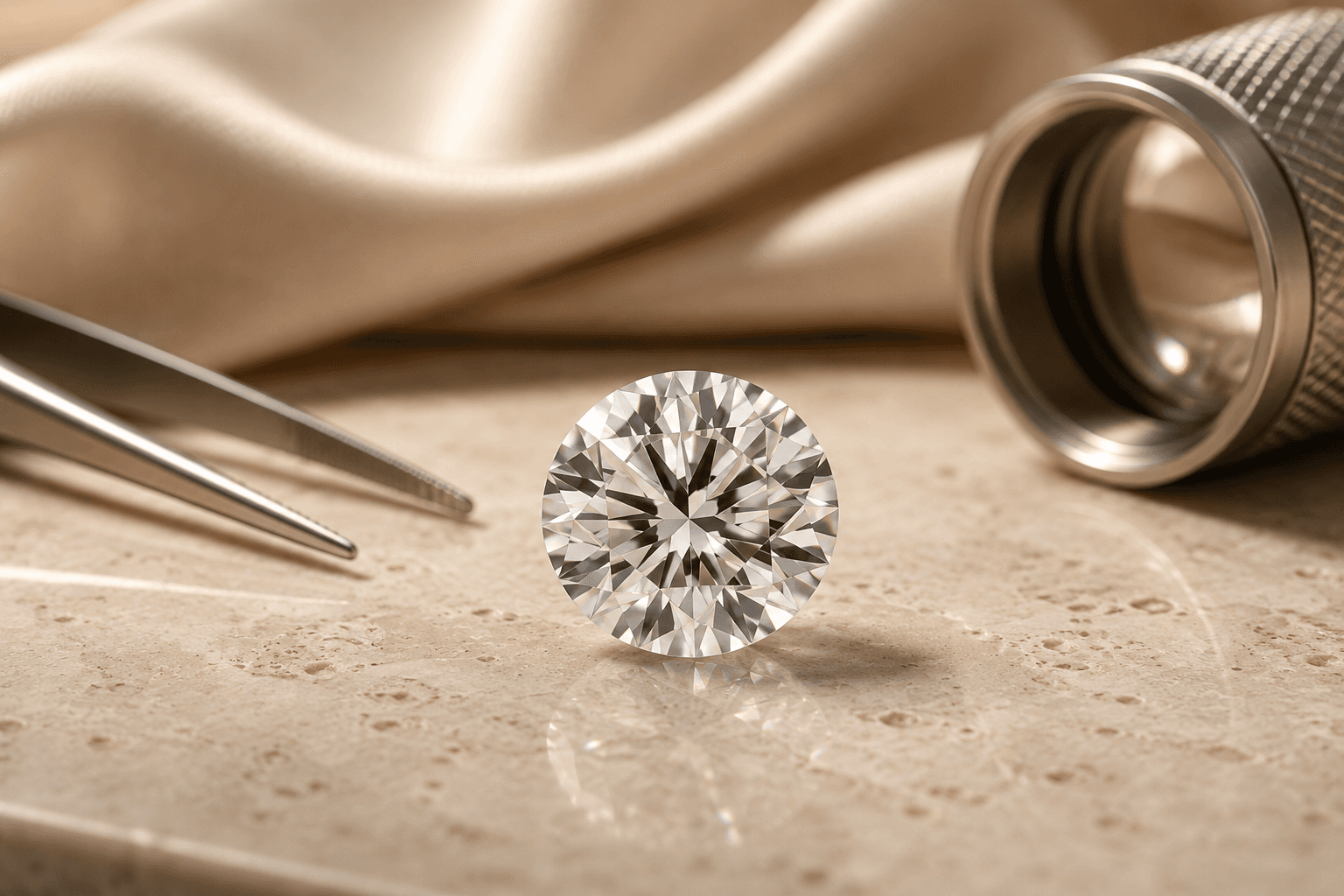
Diamond cut describes how precisely a diamond's facets are shaped, aligned, and polished to return light. On a grading report it appears as a cut grade for round brilliants, plus separate polish and symmetry lines. For most engagement rings the practical question is simpler: does the stone look alive on the hand? Light performance in wear usually matters more than treating Excellent as a checkbox.
Two round diamonds on a white tray. Same carat. Same color. Same clarity. Both graded Excellent cut. A buyer comparing certificates online would call them interchangeable. In person, one returns light evenly across the crown. The other looks acceptable under the spotlight and slightly tired everywhere else. That gap is why cut sits at the center of how experienced advisors think about diamonds.
What Diamond Cut Actually Measures
Cut grading evaluates proportions, facet alignment, and surface finish, then summarizes how efficiently a diamond is likely to return light. For rounds, laboratories combine table size, depth, crown and pavilion angles, symmetry, and polish into an overall cut grade. The measurement is about craftsmanship and light behavior, not the diamond's natural origin.
The report tells you how the stone was cut. Your eyes, in the ring you plan to build, tell you whether that cutting succeeded. How to read a diamond certificate shows where cut, polish, symmetry, and proportion fields appear on the page.
Why Cut Is the Most Important Quality Factor
Color and clarity describe what formed inside the crystal. Carat describes weight. Cut determines what you see when light hits the stone. A well-cut diamond can face up whiter and cleaner than its color and clarity grades suggest. A dull diamond with top grades still looks dull.
That is why Our Approach at Hourglass prioritizes how the stone handles light before debating alphabet upgrades. Cut is not one factor among four. It is the factor that makes the other three visible. Is diamond cut the most important C frames the same priority within the Four Cs.
Cut vs Shape
Shape is the outline viewed from above: round, oval, emerald, cushion. Cut is how well the facets inside that outline move light. A round diamond can be Excellent or Fair while the shape stays the same. Retail language blurs the two constantly, which pushes buyers toward color and clarity because those numbers feel concrete.
Diamond cut vs diamond shape explains the distinction in more detail. Choose shape for style first. Then evaluate cut for performance within that shape.
The GIA Cut Scale
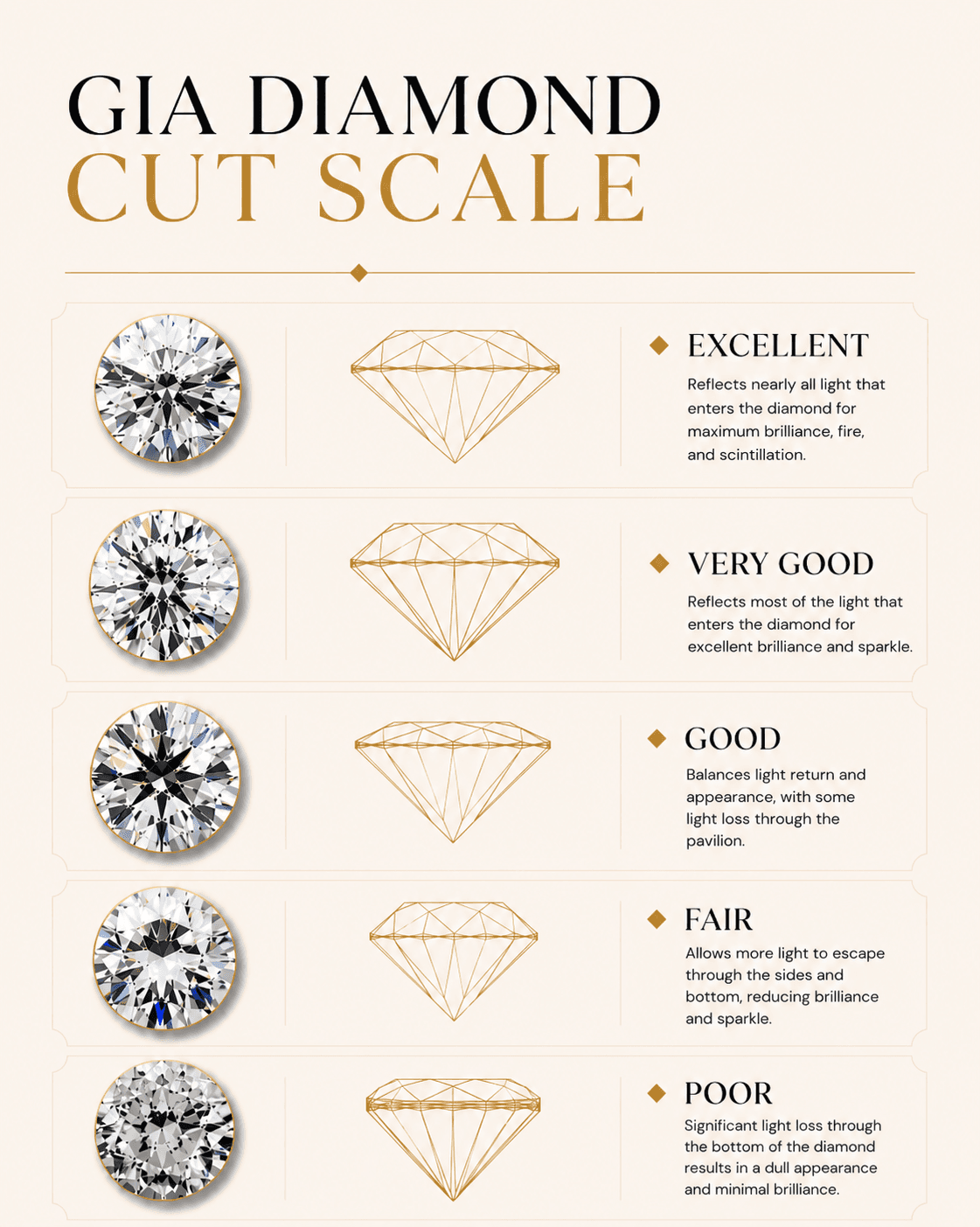
For round brilliant diamonds, the Gemological Institute of America assigns cut grades from Excellent at the top through Very Good, Good, Fair, and Poor at the lower end. Each step reflects how closely proportions, symmetry, and polish fall within ranges associated with strong light return.
The scale is a shared language for laboratories, jewelers, and buyers. It does not automatically tell you which diamond will look brightest in your solitaire, halo, or bezel. That is why the grade is a starting point, not a finish line.
What Excellent Actually Means
Excellent on a GIA report means the diamond's proportions, symmetry, and polish fall within ranges the laboratory associates with strong performance. It does not mean every Excellent stone looks identical. Table percentage, crown angle, and lower-girdle length can still vary inside the grade.
For buyers who want maximum sparkle on the hand, Excellent is the right baseline for round brilliants when the budget allows. Excellent vs very good diamond cut compares the next step down when budget is tight.
Cut vs Polish vs Symmetry
Cut grade summarizes overall light performance for rounds. Polish describes surface smoothness after cutting. Symmetry describes how precisely facets align with one another. Reports list all three separately. A diamond can show Excellent polish and symmetry while still performing differently from another Excellent stone because proportions differ.
Triple Excellent, sometimes called Triple Ex, means Excellent on cut, polish, and symmetry. That is a useful shorthand for craftsmanship. It still does not replace viewing the stone. Diamond cut vs polish vs symmetry walks through each field.
Proportions and Why They Matter
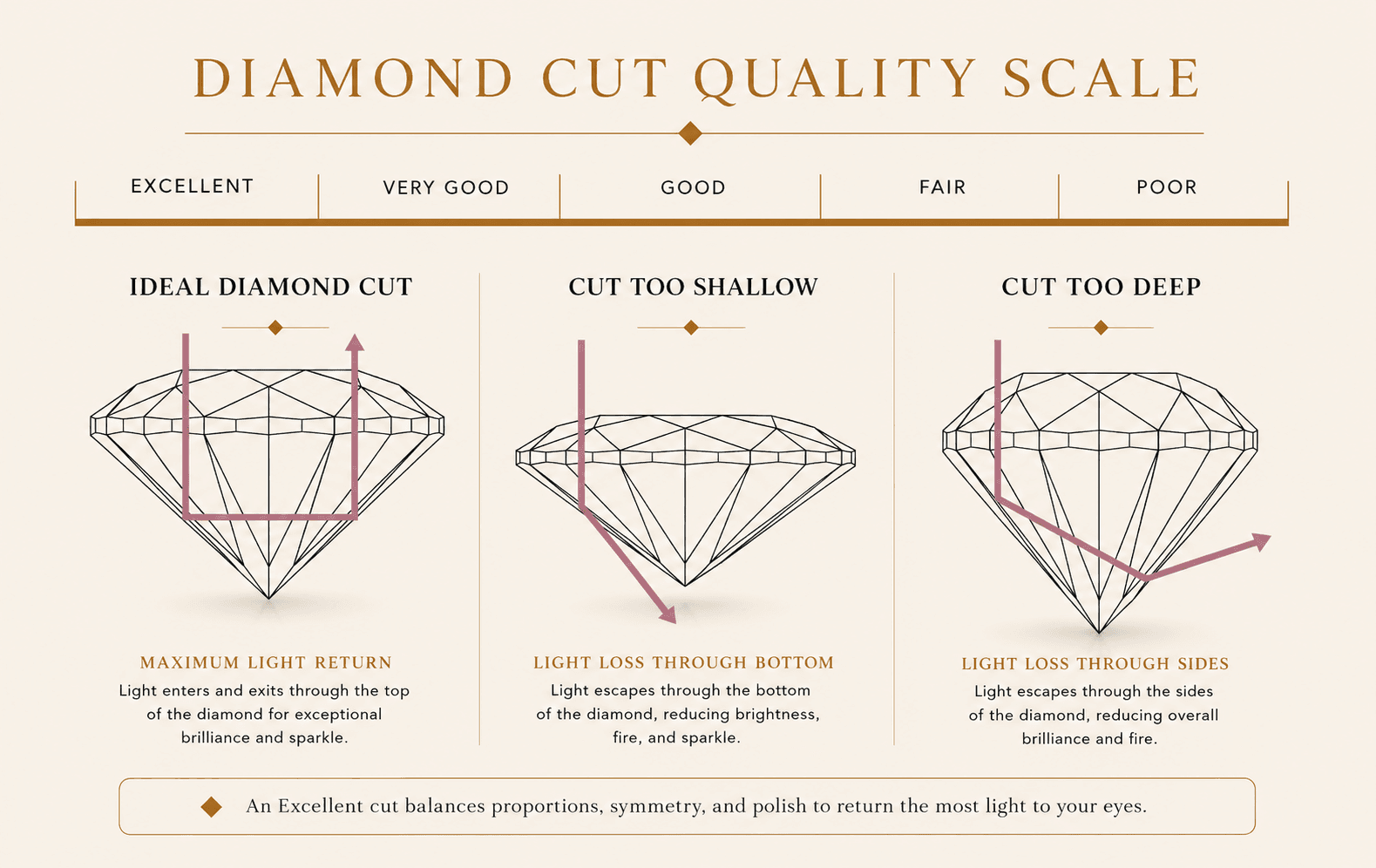
Proportions describe the relationship between table size, depth, crown height, and pavilion angle. They control whether light stays inside the diamond long enough to reflect back through the crown or escapes through the sides and bottom. Shallow cuts can leak light downward. Deep cuts can trap light or hide weight where you cannot see it.
Ideal diamond cut proportions lists common reference ranges for round brilliants. Proportions explain much of why two diamonds with the same cut grade can behave differently.
Brilliance, Fire, and Scintillation
Brilliance is the return of white light. Fire is dispersion into colored flashes. Scintillation is the pattern of light and dark that appears when the diamond moves. Together they produce what most people call sparkle. Cut quality governs how well all three appear.
Diamond sparkle explained is the umbrella guide. What is diamond brilliance, diamond fire explained, and what is diamond scintillation go deeper on each effect.
Light Return and Light Leakage
Light return describes how much entering light reflects back to your eye. Light leakage is the opposite: light that exits through the pavilion or girdle instead of returning face-up. Leakage is why some diamonds look sleepy even when color and clarity grades read well.
Diamond light return explained covers return in detail. Strong return is the foundation for brilliance, fire, and scintillation. Without it, higher grades on paper rarely rescue the wearing experience.
Why Two Excellent Diamonds Can Perform Differently
The cut grade compresses many measurements into one word. Two Excellent rounds can differ in table size, crown angle, and facet precision in ways that change how evenly light pools across the crown. One may show crisp contrast as it moves. The other may look flat under restaurant light.
That is routine, not exotic. It is why side-by-side comparison matters and why a summary line alone is an incomplete buying strategy. If you are working from a listing, upload the report to Diamond Intelligence to translate proportion data into practical questions before you view the stone.
Fancy Shape Cut Considerations
Oval, cushion, emerald, pear, and other fancy shapes rarely receive an overall cut grade on GIA reports. Polish and symmetry are graded. Overall light performance is left to visual evaluation. Length-to-width ratio, bow ties, and open tables all change how forgiving a shape is on color and clarity.
Do fancy shape diamonds have cut grades explains the gap. Fancy shapes demand more in-person judgment, not less.
Diamond Intelligence and Beyond the Grading Report
A report records measurements in controlled laboratory conditions. It does not show how lively the diamond looks when it moves, how contrast patterns form in your metal color, or whether the stone looks smaller than its carat weight because of depth. Two diamonds with matching grades can perform differently because proportions and facet precision differ.
Diamond Intelligence helps translate proportion and symmetry data from a specific report into questions you can ask before you commit. Side-by-side viewing still wins when you can arrange it. Natural vs lab diamonds covers origin; cut standards apply to both.
Hourglass Cut Standards
Hourglass prioritizes visible beauty on the hand over paper perfection. For round brilliants, Excellent cut is our baseline when performance is the goal. We still review proportion data and compare stones side by side because Excellent alone is not a substitute for liveliness.
We do not recommend accepting a dull stone because other grades look strong on the report. Cut should support the ring, not consume budget for sparkle you cannot see, and not become the reason for regret after the proposal. Freed budget from invisible color or clarity upgrades often funds the performance difference you will actually notice.
How a Graduate Gemologist Reads Cut
A Graduate Gemologist begins face-up at arm's length, then tilts the stone to watch contrast move across the crown. The report comes after the eye test: whether light returns evenly, whether dark areas dominate, whether the spread looks generous for the carat weight.
That order protects buyers from paying for letters and from rejecting lively stones because of internet rules that ignore proportion detail. Why work with a Graduate Gemologist explains who leads that review at Hourglass.
Charlotte, Surrounding Markets, and Clients Nationwide
Many Charlotte-area buyers compare cut in private appointment rather than under sales-floor spotlights alone. Hourglass works with clients throughout the Charlotte metro, including South Charlotte, Ballantyne, Matthews, Waxhaw, Weddington, Marvin, Pineville, Huntersville, Union County, Lake Norman, Fort Mill, and nearby communities.
We also work with clients around the U.S. by appointment and remote consultation when that pace fits better than a local visit. Whether you are comparing two Excellent rounds or evaluating an oval for bow-tie, the standard stays the same: lively on the hand. Begin the conversation when you want a Graduate Gemologist to review specific stones with you.
What is diamond cut?
The craftsmanship behind a diamond's facets: how proportions, symmetry, and polish work together to return light. Not the same as shape. Graded Excellent through Poor for round brilliants on GIA reports.
Is cut the most important of the Four Cs?
For most buyers, yes. Cut governs brightness and sparkle on the hand. Color and clarity describe purity. Carat describes weight. Protect cut before chasing invisible grade upgrades.
What is the difference between cut and shape?
Shape is the outline: round, oval, emerald. Cut is how well the facets return light inside that outline. You can change performance without changing shape.
What does Excellent cut mean?
On GIA round reports, Excellent means proportions, symmetry, and polish fall within ranges linked to strong light return. Individual stones can still differ within the grade.
Does cut affect sparkle?
Yes, more than any other factor. Sparkle combines brilliance, fire, and scintillation. Cut controls how efficiently light returns. A dull cut cannot be fixed by higher color or clarity.
Why can two Excellent cut diamonds look different?
The grade summarizes many measurements. Table size, crown angle, and facet precision can vary inside Excellent and change how evenly light returns. Compare stones side by side.
Related topics
Continue Exploring
If you would like this applied to your own diamond or ring, a private conversation is available.