
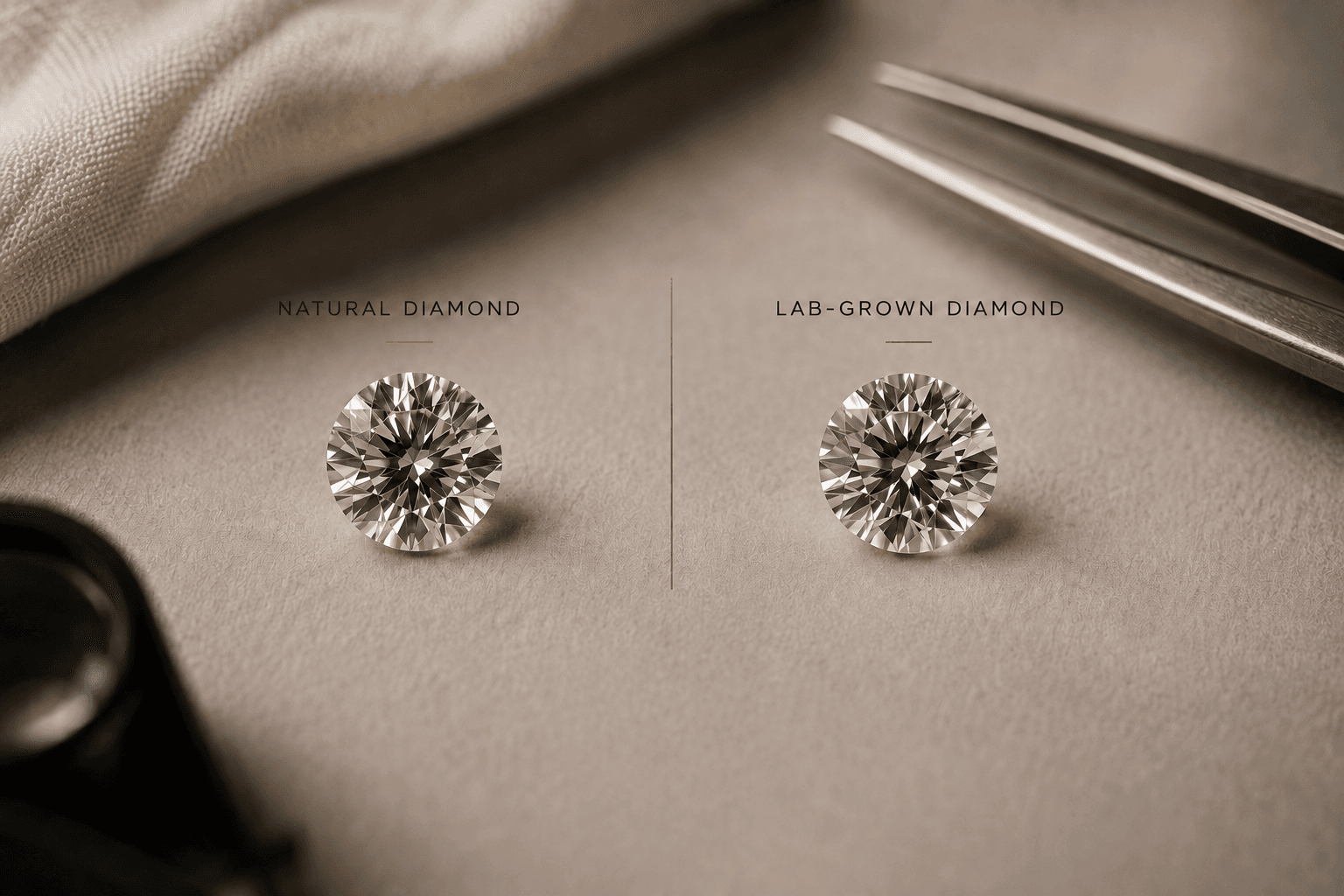
Lab-grown and natural diamonds are both diamond. Same crystal structure, same hardness, same ability to return light when cut well. The meaningful difference is origin and what that origin represents to you: geological rarity and tradition on one side, laboratory precision and often more budget flexibility on the other. Neither path guarantees a beautiful stone. Performance still decides what you see on the hand.
Two diamonds sit on the tray. Same carat. Same color grade. Same clarity. Both return light beautifully. One formed over billions of years beneath the earth. The other grew in a laboratory over several weeks. Without specialized equipment, most people cannot tell which is which. The conversation that follows is rarely about optics. It is about meaning, budget, and what each person needs the stone to represent.
That is the real decision hiding inside the natural versus lab question. Chemistry is largely settled. Both can be graded, certified, and set in an engagement ring that lasts a lifetime. What remains is personal: whether geological rarity matters to you, whether laboratory origin feels innovative or insufficient, and how you want to allocate the budget that origin choice unlocks or constrains.
What Lab-Grown and Natural Diamonds Are
A natural diamond formed deep in the earth under heat and pressure, then traveled toward the surface over geologic time. A laboratory-grown diamond recreates crystalline growth in a controlled environment over weeks or months. Both are diamond. Neither is a simulant. Both can receive grading reports from major laboratories.
Buyers sometimes assume one path is automatically more honest or more beautiful. That is not how gemology works. A well-cut lab diamond outperforms a mediocre natural one. A stunning natural stone can justify its premium when rarity and story matter to you. The material is shared. The judgment is individual.
Why This Debate Gets Loud
Natural diamonds carry a story older than any jewelry house. They formed under conditions no laboratory fully replicates, traveled to the surface through ancient volcanic pipes, and survived a long supply chain before reaching a ring box. For many buyers, that history is part of the romance. The stone is not only beautiful. It is rare in a way that predates the engagement it will mark.
Lab-grown diamonds arrive with a different story: precision, accessibility, and the same crystal structure achieved through human engineering. They are not simulants. They are not cubic zirconia dressed up in marketing language. They are diamond, full stop. What they do not carry is geological scarcity, and for some buyers that distinction matters deeply.
The noise in this debate often comes from people arguing past each other. One side defends meaning. The other defends value. Both can be right without agreeing. The mistake is treating origin as a proxy for quality before you have defined what quality means visually.
What Is Actually the Same
Natural and laboratory-grown diamonds share the same fundamental crystal structure. They test as diamond. They can display comparable brilliance, hardness, and durability when cut well. Grading laboratories evaluate both using the same color, clarity, and proportion standards. A G VS2 Excellent round is described the same way on paper whether the stone formed underground or in a chamber.
That parity is useful. It means you can compare performance using the same tools: grading reports, side-by-side viewing, and judgment about how the stone handles light. It also means the same pitfalls apply to both. A mediocre cut on a strong certificate disappoints regardless of origin. A beautiful stone with a poorly positioned inclusion can frustrate in a halo setting whether it is natural or lab.
What Is Actually Different
Price is the most immediate difference most buyers encounter. At comparable grades, lab-grown diamonds typically cost less per carat. That gap can allow a larger stone, a higher cut standard, or more budget for the setting. It can also invite the trap of buying more carat without buying more beauty. A bigger lab diamond with mediocre proportions is still a mediocre diamond.
Rarity and resale expectations diverge. Natural diamonds have a long-established secondary market, though resale values for most engagement ring stones are modest regardless of origin. Lab-grown pricing has evolved quickly as production scales, which makes long-term value harder to predict. If future trade-in value is central to your decision, research carefully and ask direct questions. If the ring is a keep-forever purchase, resale may be irrelevant.
Growth characteristics can differ in subtle ways. Some lab diamonds show strain patterns or fluorescence distributions that differ from typical natural stones. These features are documented on reports and are usually invisible in wear. They matter when you are verifying origin, not when you are judging beauty on the hand. Fluorescence in natural vs lab diamonds covers that distinction in more detail.
Why Two Diamonds With Similar Grades Can Still Look Different
Identical summary lines do not mean identical diamonds. Cut precision varies within a grade. Inclusion placement changes what you see face-up. Depth and spread change how large a carat weight looks. Fluorescence can soften or sharpen appearance in daylight for some stones.
This is true for lab and natural stones alike. Origin does not replace side-by-side viewing. How diamond cut affects light performance and what is diamond clarity explain why paper grades are only the start. At Hourglass, we would rather pass on attractive grades than recommend a stone that fails in the setting you are building.
Certification and Grading Reports
Both paths should come with independent grading documentation. Natural diamonds are commonly graded by GIA and other established laboratories. Laboratory-grown diamonds are frequently graded by IGI and, increasingly, by GIA with clear laboratory-grown identification on the report.
Read reports the same way regardless of origin: verify the report number, study proportions, read the inclusion plot, and ask what the summary leaves out. How to read a diamond certificate is the field guide. Do lab-grown diamonds have certificates answers the paperwork question for lab stones specifically. GIA certification explained and IGI certification explained add laboratory context when you are comparing sellers.
When you have a specific report in hand, Diamond Intelligence can help translate grades and proportions into practical performance questions before you view the stone in person.
The Mistake We See Most Often
Buyers settle origin before they settle performance. They debate natural versus lab for weeks, then choose whichever option fits the budget on paper without comparing how stones actually look. The regret that follows is rarely about geology. It is about a diamond that looked fine online and felt flat in person, or about paying for clarity no one will ever see because the budget was locked into origin before cut quality was protected.
Performance should come first. Decide what you need the diamond to do visually: how it should face up on the hand, how it should behave in your setting, how much presence you want without sacrificing liveliness. Once that standard is clear, origin becomes a meaningful choice rather than an abstract argument. Our Approach at Hourglass applies the same optical standard to both paths. Origin is disclosed and respected. It does not excuse a dull stone.
When Lab-Grown Diamonds Tend to Fit
You want a beautiful diamond and prefer to allocate budget toward size, cut quality, or the ring design rather than toward geological rarity. You are comfortable with laboratory origin and have thought through how you feel about long-term value. You want the same durability and brilliance without the same price per carat.
You are still unwilling to compromise on performance. Lab origin should not become an excuse to accept a stone that underperforms its grades. The same side-by-side discipline applies. Buyers who already lean lab-grown and want a practical satisfaction check often read are lab diamonds a good choice after this guide.
When Natural Diamonds Tend to Fit
Natural origin matters to you as part of the story, not only as a specification. You want the rarity narrative, the geological history, or a family tradition that assumes mined diamond. You are comfortable paying a premium for that context and you still intend to prioritize cut and eye cleanliness within the budget you set.
You are also willing to evaluate natural diamonds individually. Mined stones vary widely in character even at identical grades. The search may take longer. The right one is not always the first one that satisfies a filter.
Value, Resale, and Tradition Without Hype
Natural diamonds are often described as investments. For most engagement ring purchases, they are not. Resale value is usually a fraction of retail, and market conditions shift. What natural origin can offer is tradition, rarity in a geological sense, and a story that predates the proposal. Those are legitimate reasons to choose mined diamond if they matter to you.
Lab-grown diamonds offer a different bargain: more of the budget can go to visible quality rather than to scarcity. That is also legitimate. Neither choice is morally superior. Both require the same discipline about cut and eye cleanliness. Diamond price versus quality helps frame tradeoffs once you know which path you are on.
How a Graduate Gemologist Approaches the Decision
A Graduate Gemologist does not begin by picking a side in the origin debate. The first questions are about performance, setting, and budget. What shape? What metal? What clarity standard will actually show on the hand? Only then does origin enter as a values question rather than a shortcut.
That sequence protects buyers from the most common regrets. The House explains who leads that review at Hourglass. Why work with a Graduate Gemologist goes deeper on when trained eyes earn their place in the process.
Charlotte, Surrounding Markets, and Clients Nationwide
Many Charlotte-area couples weigh this decision in private consultation rather than on a sales floor. Hourglass works with clients throughout the Charlotte metro, including South Charlotte, Ballantyne, Matthews, Waxhaw, Weddington, Marvin, Pineville, Huntersville, Union County, Lake Norman, Fort Mill, and nearby communities. The process is appointment-based, calm, and focused on comparison rather than inventory pressure.
We also work with clients around the U.S. by appointment and remote consultation when that pace fits better than a local visit. Origin, budget, and performance standards do not change because the conversation happens over video. The discipline stays the same: disclose origin, read the report, compare stones honestly, and recommend only what meets the optical standard you set.
If you want a private advisor who is not limited to what happens to be in a case today, charlotte diamond advisor guide explains how that model works locally. Begin the conversation when you are ready to review options on your terms.
How to Choose Without Regret
Start with a performance standard, not an origin vote. View diamonds in person when you can. Compare stones with similar reports and notice which your eye returns to. Ask where budget would go if you shifted one color grade or one clarity grade. Ask how cut quality was judged beyond the certificate for your shape.
If you are working from listings alone, use the report as a starting point, not a finish line. Diamond Intelligence can help translate proportion data into practical performance context for a specific stone you are considering. So can a Graduate Gemologist who will tell you plainly when a certificate overstates what you are likely to see.
Origin deserves an honest conversation. So does budget. But the diamond you propose with will be worn, not debated. Choose the path that aligns with your values, then hold that path to the same optical standard you would demand either way. Diamond buying tips from jewelers covers the habits that protect any purchase, lab or natural.
Natural and lab are not moral opposites. They are two supply paths to the same material. The right choice is the one you can explain with conviction, defend with performance, and still love on an ordinary Tuesday years from now.
Are lab-grown diamonds real diamonds?
Yes. They are crystalline carbon with the same fundamental structure as natural diamonds. They test as diamond and are durable enough for daily wear. They are not simulants.
Are natural diamonds better than lab-grown diamonds?
Neither origin guarantees a better diamond. Natural diamonds carry rarity and tradition many buyers value. Lab-grown diamonds often allow more budget for size or cut. Beauty depends on cut, inclusion placement, and side-by-side viewing.
Which holds value better, natural or lab-grown diamonds?
Natural diamonds have a longer-established secondary market, though most engagement ring stones resell below purchase price either way. Lab-grown pricing has shifted as production scales. If the ring is keep-forever, resale may be the wrong lens.
Do lab-grown diamonds have certificates?
Yes. IGI and GIA commonly grade laboratory-grown diamonds. Reports document weight, color, clarity, proportions, and origin. Read proportions and the plot, not only the summary line.
How do you choose between lab and natural diamonds?
Set a performance standard first. Decide whether rarity or budget flexibility matters more to you. Compare stones side by side. Hold either path to the same cut and eye-clean standard.
When should you ask a Graduate Gemologist?
When two reports look alike but prices diverge, when you are unsure how grades translate to beauty in your setting, or when you want a second opinion before a significant purchase. Trained review reads for wear, not for debate.
Related topics
Continue Exploring
If you would like this applied to your own diamond or ring, a private conversation is available.