
Diamond clarity describes internal and surface features in a diamond as gemologists see them under ten-power magnification. On a grading report it appears as a letter from Flawless down through Included. For most engagement rings the practical question is simpler: will you see anything on the hand? Eye clean in your setting usually matters more than chasing the top of the scale.
A buyer once refused an SI1 diamond because an article online said to stay above VS. The stone was eye clean in every lighting we tried. The inclusion sat beneath a prong where it would never catch light from the table. The VS2 they chose instead had a crystal dead center under the crown. They saw it within a week of wearing the ring. Clarity is part of the story. It is not the whole story.
What Diamond Clarity Actually Measures
Clarity grading records inclusions inside the crystal and blemishes on the surface. Laboratories count how many features exist, how large they are, what type they are, and where they sit relative to the face-up view. The result is a standardized grade that helps compare diamonds on paper.
That grade is useful. It is not the same as beauty in wear. Most inclusions are tiny. Many never affect how a diamond looks at arm's length. The report tells you what exists. Your eyes, in the ring you plan to build, tell you what matters.
Inclusions vs Blemishes
Inclusions formed inside the diamond as it grew deep in the earth. They can appear as pinpoints, feathers, crystals, clouds, or needles trapped in the crystal structure. Blemishes are on the surface: tiny polish lines, nicks, or abrasions that may occur naturally or during cutting.
Gemologists evaluate both under magnification. Internal features usually influence the grade more because they are part of the stone. Minor surface blemishes are often small enough to polish away or hide once the diamond is set. How to read a diamond certificate shows where the clarity grade and inclusion plot appear on the page.
The GIA Clarity Scale
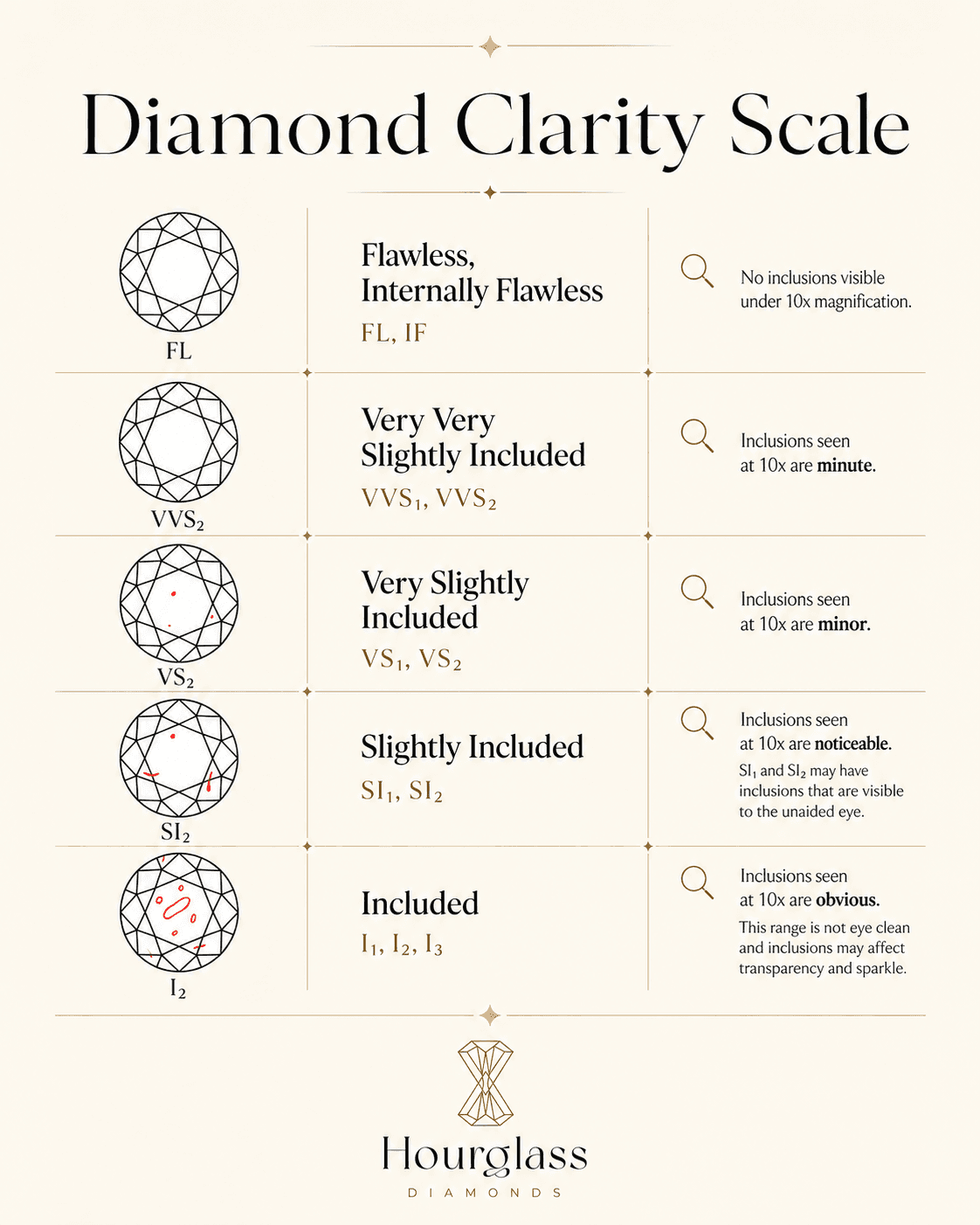
The Gemological Institute of America clarity scale runs from Flawless at the top to Included at the lower end. Each step reflects how easy it is for a trained grader to see characteristics under ten-power magnification, and in some lower grades, whether features may be visible without magnification.
The scale is a shared language for laboratories, jewelers, and buyers. It does not automatically tell you which diamond will look clean in your halo, solitaire, or bezel. That is why the grade is a starting point, not a finish line.
What Each Grade Means in Practice
Flawless (FL): no inclusions or blemishes visible under ten-power magnification. Internally Flawless (IF): no inclusions; only very minor surface blemishes that may be polishable. Both are exceptionally rare and command strong premiums.
Very Very Slightly Included (VVS1 and VVS2): extremely small inclusions, difficult even for experienced graders to locate. Very Slightly Included (VS1 and VS2): minor inclusions visible under magnification, usually eye clean in well-cut stones under two carats. For a focused VS comparison, see VS1 vs VS2 diamond clarity.
Slightly Included (SI1 and SI2): inclusions easier to see under magnification; may or may not be visible face-up. SI1 is often eye clean when placement is favorable. SI2 requires individual inspection. Slightly Included grades can offer strong value when the stone still looks crisp in wear.
Included (I1, I2, and I3): obvious inclusions that may be visible without magnification and can affect transparency or durability. Hourglass does not offer I1 through I3 diamonds. Clarity should support beauty, not undermine it.
What Eye Clean Means
Eye clean is not a GIA grade. It means inclusions are not visible to the naked eye from the top at normal viewing distance in everyday light. Many VS and SI diamonds qualify. Some higher grades still show a speck from the table in certain lighting.
Engagement rings are worn, not microscoped. Eye clean diamonds explained goes deeper on the standard that usually governs real ring decisions.
Clarity Is Not the Same as Beauty
A flawless diamond with weak proportions can look flat. An eye-clean SI1 with strong light return can look vivid. Clarity describes internal geography. Beauty describes how light moves, how the stone faces up, and how it feels on the hand.
Overpaying for letters you cannot see is one of the most common clarity mistakes. Refusing to look at SI stones because of internet rules is another. The diamond decides, not the category alone.
When Clarity Matters and When It Does Not
Clarity matters more in step cuts with open tables, such as emerald and Asscher, where inclusions are easier to read. It matters more as carat weight increases because features scale with the stone. It matters when an inclusion sits under the table where light enters first.
Clarity matters less when inclusions are white, peripheral, or hidden by prongs. It matters less when cut is strong enough to scatter light across the face. It matters less when your standard is eye clean rather than laboratory perfect.
Location Matters More Than Count
Two diamonds can share a clarity grade and behave differently. One SI1 has a feather tucked at the girdle where a prong will cover it. Another SI1 has a dark crystal under the table where light enters first. The alphabet matches. The wearing experience does not.
Advisors read the inclusion plot with the ring design in mind. A plot without setting context is a map without a destination.
Clarity vs Sparkle and Light Performance
Sparkle comes primarily from cut: how facets return light, how contrast patterns form, how the stone moves. Tiny inclusions in eye-clean diamonds rarely block that performance. Large or centered inclusions, or included grades that reduce transparency, can make a diamond look sleepy even when the report reads well.
If sparkle is the priority, protect cut first. How diamond cut affects light performance explains why performance governs what you perceive before clarity letters do.
Clarity vs Color and Value
Budget is finite. Climbing from SI to VVS may cost more than moving one color step, yet produce no visible gain on the hand. Many buyers do better trading a clarity grade they cannot see for cut, carat, or the setting they want.
Diamond color vs clarity walks through how those tradeoffs interact. Best diamond clarity for engagement rings frames practical ranges for ring buyers.
Natural and Lab-Grown Diamonds
Both natural and laboratory-grown diamonds can contain inclusions. Growth history differs, but the material is the same crystal. Reports document clarity for either origin using the same scale. Origin does not remove the need to view the individual stone.
Why a Grading Report Alone Is Not Enough
A report summarizes what a laboratory observed in controlled conditions. It does not show how lively the diamond looks when it moves, how inclusions behave in your metal color, or whether a feature flashes under restaurant light. Two diamonds with the same clarity grade can perform differently because placement and cut differ.
If you are working from a listing, Diamond Intelligence can help translate plot and proportion data into practical questions before you commit. Side-by-side viewing still wins when you can arrange it.
Hourglass Clarity Standards
Hourglass does not sell I1, I2, or I3 diamonds. Those grades often show obvious inclusions that distract in wear or affect durability. SI2 may be considered only after individual inspection confirms the stone is eye clean in the intended setting.
Our standard is visible beauty on the hand, not perfection under magnification. Clarity should support the ring, not replace cut, not consume budget for features no one will see, and not become a source of regret after the proposal.
How a Graduate Gemologist Reads Clarity
A Graduate Gemologist begins with face-up viewing at arm's length, then from the side, then in the setting style you have chosen. The plot comes after the eye test: where features sit, whether they are dark or white, whether they reach the surface.
That order protects buyers from paying for paper and from rejecting beautiful stones because of rules that ignore placement. Why work with a Graduate Gemologist explains who leads that review at Hourglass.
Charlotte, Surrounding Markets, and Clients Nationwide
Many Charlotte-area buyers review clarity in private appointment rather than under sales-floor pressure. Hourglass works with clients throughout the Charlotte metro, including South Charlotte, Ballantyne, Matthews, Waxhaw, Weddington, Marvin, Pineville, Huntersville, Union County, Lake Norman, Fort Mill, and nearby communities.
We also work with clients around the U.S. by appointment and remote consultation when that pace fits better than a local visit. Whether you are comparing two plots or holding one stone up to a window, the standard stays the same: eye clean in wear. Begin the conversation when you want a Graduate Gemologist to review a specific stone with you.
What is diamond clarity?
A standardized measure of internal inclusions and surface blemishes under magnification. Graded Flawless through Included on GIA reports. Not the same as eye clean or sparkle.
What clarity grade is best for an engagement ring?
No single grade fits every ring. Most strong choices are eye clean in the VS or SI range. Shape, size, setting, and cut change the answer. Compare stones side by side rather than chasing flawless on paper.
What does eye-clean mean?
No visible inclusions face-up at normal distance in everyday light. Not a formal GIA grade. Many SI stones qualify when placement is favorable.
Are SI1 or SI2 diamonds worth considering?
Often yes, when each stone is viewed individually. SI1 is frequently eye clean. SI2 requires careful inspection. Hourglass evaluates SI2 case by case.
Are flawless diamonds worth the extra cost?
For rarity collectors, sometimes. For most ring buyers, well-chosen VS or SI stones look the same in wear. The premium often buys reassurance, not visible difference.
Does clarity affect sparkle?
Cut affects sparkle more. Eye-clean inclusions rarely block light return. Large centered features or included grades that reduce transparency can dull a stone. Choose liveliness first.
Related topics
Continue Exploring
If you would like this applied to your own diamond or ring, a private conversation is available.