
How to Read a Diamond Certificate
By Justin Smith, Graduate Gemologist · Hourglass Diamonds
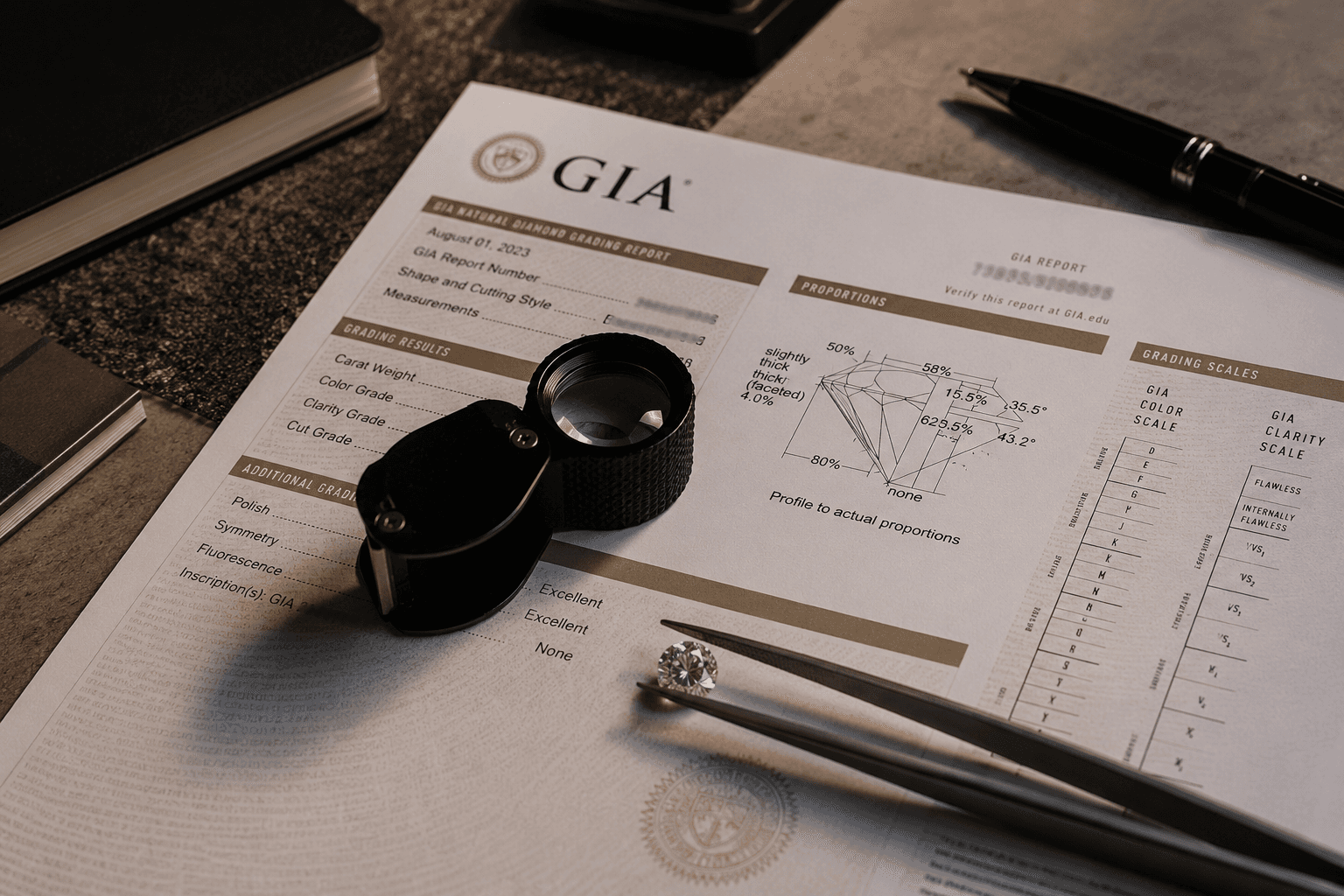
A diamond certificate tells you what a laboratory measured: weight, color, clarity, proportions, and where inclusions sit on a plot. It does not tell you whether the stone will feel right on the hand. Read the report in that order. Summary first for orientation, then proportions and the plot for performance, then ask what the grades leave out.
Most buyers open a grading report and go straight to the summary line: carat, color, clarity, cut. That is natural. Those four numbers feel like the answer. On a website filter menu, they often are. On a diamond you will wear for decades, they are the headline, not the story.
Experienced reviewers read the same page differently. They confirm identity first, then look at proportions, then study the inclusion plot, then ask what the grades leave out. The goal is not to memorize a manual. It is to translate paper into judgment. If you want the full field guide in one place, you are in the right article. Lab-specific context lives in our GIA, IGI, and GCAL 8X guides when you need them.
What a Certificate Can and Cannot Tell You
A certificate can confirm that the stone matches a documented identity. It can give you shared language for comparing options from different sellers. It can record proportions that explain light behavior on rounds and many fancy shapes. It can show where inclusions sit, which matters more than how many exist.
A certificate cannot tell you how the diamond will look in afternoon light on a size-six finger. It cannot fully capture cut precision inside an Excellent bucket. It cannot predict whether an inclusion will flash in your halo setting. It cannot replace side-by-side viewing or tell you whether this stone is the best use of your budget.
Why diamond certification matters explains when that independent reference protects you most. What is a diamond certificate covers how the document differs from an appraisal. Both are shorter primers. This guide is the practical read-through.
How to Read Report Fields Without Getting Lost
Start with the report number and laboratory name. Match the number to the inscription on the girdle when one is present. If identity does not line up, stop and resolve that before you read grades.
Next, read the 4Cs summary as orientation only. Then move to proportions: table percentage, depth percentage, crown angle, pavilion angle, girdle thickness, and culet size on rounds. These numbers explain much of why two Excellent cuts behave differently. On fancy shapes, length-to-width ratio and depth often matter more than a single cut grade because many laboratories do not assign one.
Study the inclusion plot with your setting in mind. A feather at the girdle may disappear under a prong. A crystal under the table may catch light in a solitaire. Read fluorescence if listed. Note measurements and shape outline when you are comparing face-up size between similar carat weights.
For a dedicated walkthrough of report numbers and verification, see what is a diamond report number. For laboratory context when two stones share the same letters, read are all diamond certificates the same.
GIA, IGI, and GCAL: What Changes on the Page
GIA reports are the benchmark many buyers know first. They document the 4Cs, proportions, and a plotted diagram for most natural diamonds. GIA is widely regarded for consistent grading on natural stones. When you hold a GIA report, read proportions and the plot with the same discipline you would apply anywhere else. The laboratory name is not a substitute for performance review.
IGI appears frequently on laboratory-grown diamonds and in international inventories. The report structure looks familiar, but strictness and cut philosophy may differ from GIA. Compare IGI stones to other IGI stones when possible, and view them in person before you assume equivalence with a different laboratory.
GCAL 8X reports add performance-oriented language and optical analysis beyond the standard summary. They can be useful when light behavior is the deciding factor. They still require viewing. Performance metrics describe tendencies, not a promise of beauty in your ring.
Historical AGS and European HRD reports still appear in trade inventories. Treat them as documented measurements from their era. When laboratory standards have shifted, read the proportions and plot rather than assuming today's summary lines mean the same thing across labs.
Why Two Diamonds With Similar Reports Look Different
Identical summary lines do not mean identical diamonds. Cut precision varies within a grade. Inclusion placement changes what you see face-up. Depth and spread change how large a carat weight looks. Fluorescence can soften or sharpen appearance in daylight for some stones.
This is why experienced buyers insist on comparison. How diamond cut affects light performance explains the mechanics behind proportion differences. What is diamond clarity covers why two VS2 plots can wear differently. Ideal diamond cut proportions gives reference ranges when you want numbers beside the narrative.
At Hourglass, we treat matching reports as a starting point for viewing, not a reason to skip it. Paper grades narrow the field. Your eyes and the finished ring finish the decision.
How a Graduate Gemologist Reads the Same Page
A Graduate Gemologist reads for wear, not for trivia. Identity first. Laboratory credibility for this purchase. Proportions next because they predict light behavior on rounds and inform fancy-shape review. Then the plot with setting geometry in mind. Then the question most listings skip: is this the right tradeoff for this budget?
That sequence is conservative by design. We would rather pass on a stone with attractive grades than recommend one that fails in the setting you are building. The House explains who leads that review at Hourglass. Why work with a Graduate Gemologist goes deeper on when trained eyes earn their place in the process.
What Most People Look at First
The 4Cs summary is where almost everyone starts. Carat weight, color grade, clarity grade, and cut grade for rounds give you a quick comparison language. Two reports with identical summaries can still describe diamonds that look nothing alike in person.
Buyers also notice the certificate photograph and any comments about fluorescence or treatments. These are worth reading. They are still not the full picture. A report is a standardized description of measurable traits. It is not a performance guarantee.
What Experienced Reviewers Look at First
They verify the report number matches the stone and that the laboratory is one they trust for the decision at hand. Then they move to proportions: table percentage, depth percentage, crown and pavilion angles, girdle thickness, culet size. For rounds, these numbers explain much of why two Excellent cuts can behave differently.
They read the clarity plot with the setting in mind. An inclusion under a prong may never matter. A crystal under the table may flash in a halo. Symmetry and polish grades matter, but they are supporting details. Proportions and inclusion placement usually tell the richer story.
Which Sections Deserve Your Attention
Proportions deserve more attention than most first-time readers give them. They describe how the diamond was shaped, which is closely tied to how it handles light. The inclusion plot deserves attention because it shows where features sit, not just how many exist. Measurements and shape outline help you compare face-up size between stones of similar carat weight.
Cut grade on a round is a useful shorthand. On fancy shapes, where formal cut grades may be absent or inconsistent, proportions and in-person viewing matter more. Treat the summary line as orientation, then spend your reading time where performance actually lives.
Which Sections Are Often Overemphasized
Color and clarity grades receive enormous weight because they are easy to compare online. Small differences between adjacent grades can carry large price gaps with little visible difference once the diamond is set. Flawless clarity sounds reassuring. Eye clean is usually the standard that governs daily wear.
Carat weight is precise on the report and misleading in isolation. Weight is not spread. A deep 1.00 carat round can look smaller face-up than a well-proportioned 0.95. Buyers who optimize only the summary line often overpay for letters and numbers that never show up on the hand.
What Certificates Do Well
They create a shared language. They confirm weight and document grades under consistent laboratory standards. They let you compare stones from different sellers without guessing. They provide measurements that make it possible to ask better questions.
For natural diamonds, they record origin-related features laboratories test for. For lab-grown stones, they document growth method where listed. A trustworthy report reduces uncertainty. It gives honest buyers and honest sellers a common reference point.
What Certificates Cannot Tell You
They cannot tell you how the diamond will look on your partner's hand in afternoon light. They cannot fully capture cut precision within a grade bucket. They cannot predict how an inclusion will behave in your chosen setting. They cannot replace side-by-side comparison.
They also cannot tell you whether this particular stone is the right use of your budget. That requires tradeoff thinking: where to protect performance, where to accept a lower grade, whether origin matters to you personally. Our Approach at Hourglass treats the report as the opening of that conversation, not the end.
When Diamond Intelligence Helps
When you have a specific report in hand, Diamond Intelligence can help translate measurements into performance context. Upload the certificate or enter the report details. Use it to prepare sharper questions before you view stones in person. It supports judgment. It does not replace your eyes or a gemologist when the purchase is significant.
Diamond Intelligence is especially useful when you are comparing two similar summaries, reviewing a fancy shape without a cut grade, or trying to understand whether proportions sit in a strong range before you travel to see a stone.
When a Private Conversation Makes Sense
Some decisions stay easier in conversation. If two reports look alike but prices diverge, if you are unsure about inclusion placement in your setting, or if you want a second opinion before a major purchase, a calm review with a gemologist can save regret later.
Begin the conversation when you are ready for that review. Bring the report, the setting idea, and the questions the summary line did not answer.
How to Read Without Feeling Overwhelmed
You do not need to master every field on the first pass. Read the summary, then proportions, then the plot. Ask one practical question after each section: what does this suggest about how the diamond will perform, and what does it leave out?
A certificate should leave you more confident, not more anxious. It should help you compare, ask sharper questions, and recognize when two stones that look equivalent on paper are not equivalent at all. That is the standard worth holding yourself to.
What does a diamond certificate tell you?
It documents measurable traits a laboratory observed: weight, color, clarity, proportions, fluorescence when listed, and often an inclusion plot. It ties those observations to a specific stone through a report number. It does not guarantee beauty, value, or the right choice for your ring.
Does a GIA report prove a diamond is beautiful?
No. A GIA report describes grading results using consistent standards. Beauty still depends on cut precision within the grade, inclusion placement, and how the stone performs when viewed. Use the report to compare and verify. Use your eyes to finish.
How do you compare two diamond reports?
Match laboratory and report numbers to the stones. Compare proportions and plots, not only the summary line. Note fluorescence and measurements. Then view the diamonds side by side. Reports narrow the field. Comparison in person resolves what paper cannot.
When should you use Diamond Intelligence?
When you have a report in hand and want help translating grades and proportions into practical context before you buy or compare stones. It is a preparation tool, not a substitute for viewing the diamond or speaking with a gemologist on a significant purchase.
When should you ask a Graduate Gemologist?
When two reports look alike but stones do not, when inclusion placement is unclear for your setting, when fancy-shape proportions are hard to interpret, or when you want independent judgment before you commit. Trained review reads for performance and daily wear, not for memorizing field names.
Related topics
Continue Exploring
If you would like this applied to your own diamond or ring, a private conversation is available.