
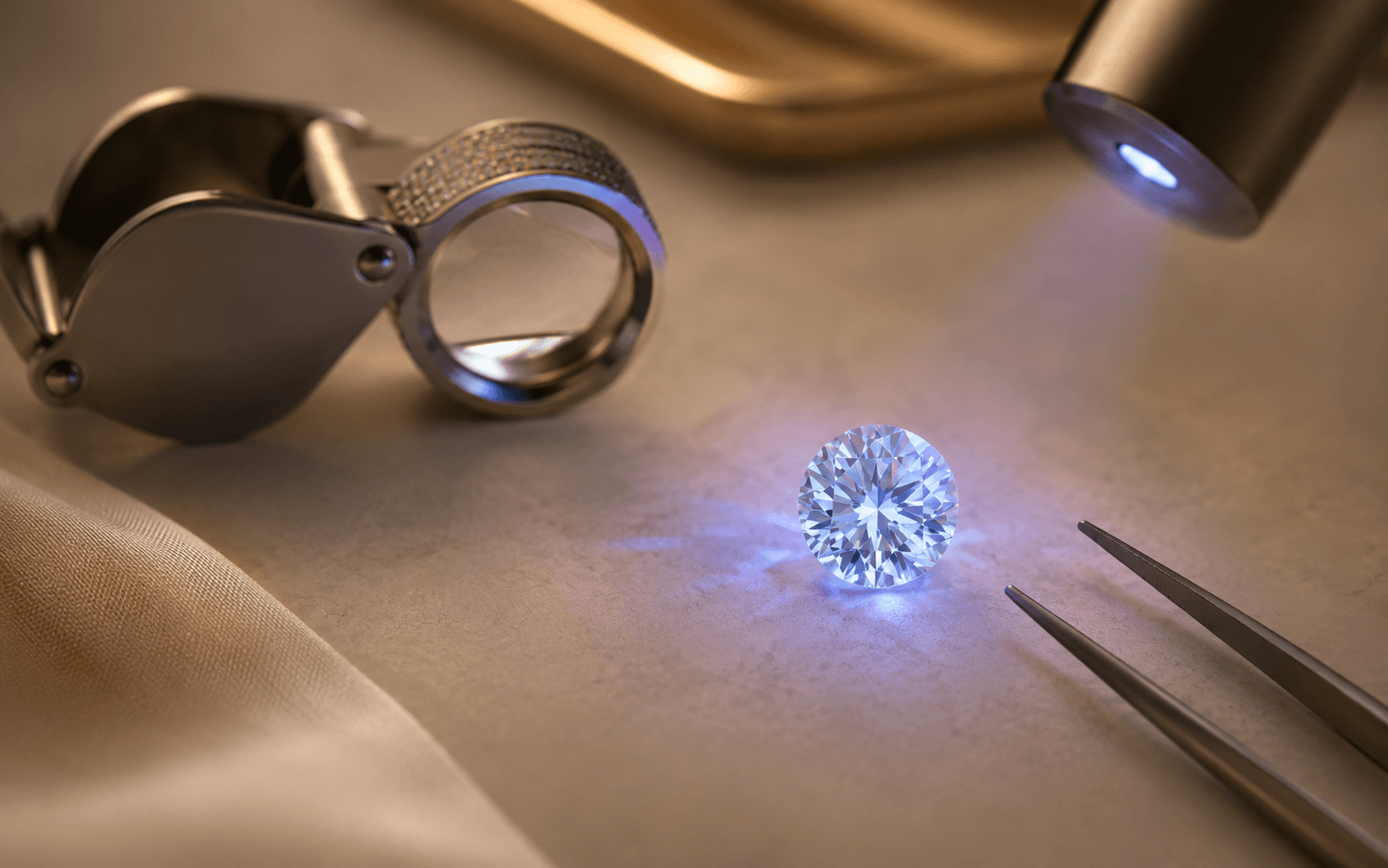
Diamond fluorescence is a glow some diamonds emit under ultraviolet light, most often soft blue. On a grading report it appears as its own line: None, Faint, Medium, Strong, or Very Strong. For most buyers it is invisible in everyday wear. It is not a flaw by default, and it is not the same as diamond color. The practical question is whether this specific stone still looks bright, crisp, and right for your ring.
Many buyers discover fluorescence only after they have already fallen for a diamond online. The summary line looks perfect. Then they notice the fluorescence field and wonder whether they should walk away. That reaction is understandable. It is also often unnecessary. Fluorescence is common, frequently neutral, and sometimes useful. What it is not is a substitute for viewing the stone.
What Diamond Fluorescence Actually Is
Fluorescence happens when trace elements inside a diamond absorb ultraviolet radiation and release visible light. Blue is the most common color gemologists record. Yellow, white, and other reactions appear occasionally. The effect is a physical property of that crystal, not a treatment and not a surface coating.
Laboratories grade fluorescence separately from color. A G color diamond can be None or Strong. A J color diamond can be either as well. That independence is why fluorescence deserves its own conversation rather than a quick pass or fail judgment.
How Common Fluorescence Is
A substantial share of diamonds show some fluorescence under UV testing. Many exhibit none. Others fall anywhere on the scale. The grade on your report simply documents how strong the reaction was in standardized laboratory conditions, not how the diamond will behave at your kitchen table.
If you have an original GIA, IGI, or supported GCAL grading report PDF for a round brilliant, Diamond Intelligence can place its documented fluorescence grade in report context. Whether fluorescence has a visible effect still requires viewing the stone under appropriate lighting.
The GIA Fluorescence Scale
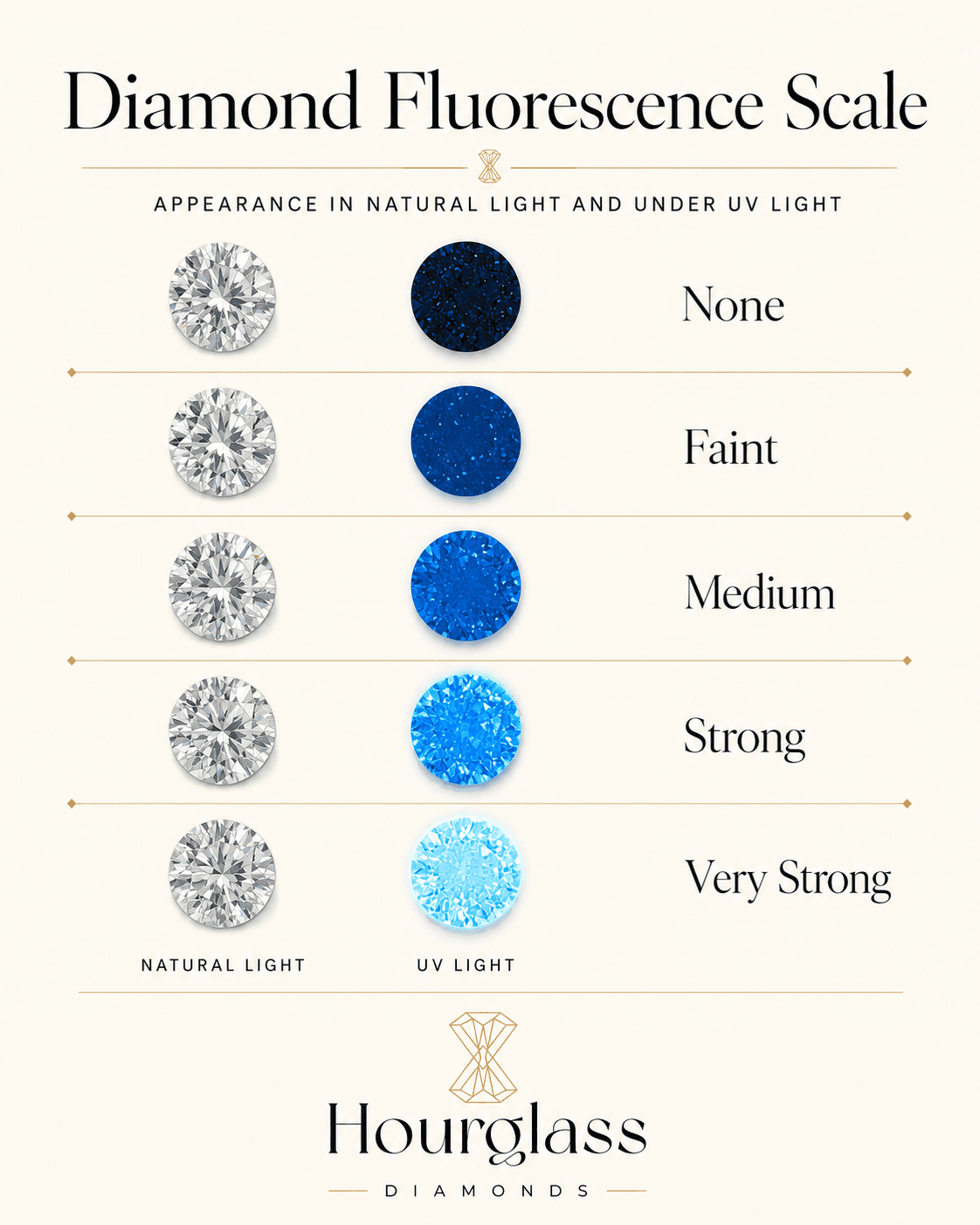
Major laboratories including GIA describe fluorescence with five standard grades. None means no observable reaction under UV. Faint means a subtle reaction that is difficult to see even under a UV lamp. Medium is easier to observe in controlled UV lighting. Strong and Very Strong produce a more noticeable glow when UV is present.
The scale measures intensity under ultraviolet light. It does not automatically predict beauty in normal wear. That distinction matters more than the label itself.
What Each Grade Means in Practice
None: the diamond showed no meaningful fluorescence reaction when graded. Everyday appearance is unaffected because there is none listed.
Faint: a subtle reaction under UV, often hard to notice even when demonstrated. Most faint stones look the same as non-fluorescent diamonds in normal lighting.
Medium: a clearer reaction under UV. Still often invisible in typical indoor environments. Worth noting on the report, not automatically worth rejecting.
Strong: a pronounced blue reaction under UV. Many strong stones still face up beautifully. This is the grade where side-by-side viewing earns its keep.
Very Strong: the most intense common category. Most stones are still attractive. A minority can show haze in certain light. Individual inspection matters most here.
For how to find the fluorescence field on a report, see how to read a diamond certificate.
When Fluorescence Is Usually Harmless
Faint and medium fluorescence rarely change what you see in restaurants, offices, or evening light. Even in daylight the glow itself is subtle. Buyers who choose these stones are often choosing them for cut, clarity, and price without ever seeing a blue reaction on the hand.
If your priority is a beautiful diamond rather than a report with every line optimized for resale anxiety, faint or medium fluorescence should not disqualify a stone before you have looked at it.
When Fluorescence Deserves a Closer Look
Strong and very strong fluorescence deserve more attention, especially on high color grades where crisp whiteness is part of the appeal. The concern is not the UV glow. It is whether transparency stays clean in the environments where you will actually wear the ring.
A small percentage of very strong stones can look slightly hazy or milky in certain lighting. Most do not. That is why blanket rules fail. For a practical helps-versus-hurts framework, see when fluorescence improves a diamond.
How Fluorescence Can Affect Color Appearance
Blue fluorescence can interact with body color because blue and yellow are complementary. In diamonds with slight warmth, outdoor daylight can occasionally make a fluorescent stone look a touch whiter than its color grade alone might suggest. The shift is usually modest, not a magic upgrade from J to D.
Indoor lighting contains less UV, so the effect is often minimal away from windows. What is diamond color explains how color is graded and why face-up appearance can differ from the certificate.
How Fluorescence Can Affect Value and Pricing
Fluorescence is not one of the traditional Four Cs, yet it can influence list prices. Stronger fluorescence sometimes correlates with modest discounts versus similar non-fluorescent stones, partly because the market has historically feared it. Faint and medium levels are often priced neutrally.
For buyers who evaluate stones individually, that discount can be an opportunity when the diamond faces up beautifully. For buyers focused on top color grades and maximum resale optics, it may feel like noise. Neither reaction is wrong. Diamond price versus quality helps frame tradeoffs once you know what you are optimizing for.
Natural and Lab-Grown Diamonds
Both natural and laboratory-grown diamonds can show fluorescence. Growth history differs, but the crystal structure is the same material. Reports document fluorescence for either origin using the same intensity scale.
If origin is part of your decision, fluorescence in natural vs lab diamonds covers how growth environment can influence fluorescence patterns. For the broader origin question, see natural vs lab diamonds.
Why a Grading Report Alone Is Not Enough
A report tells you what a laboratory observed under controlled conditions. It does not tell you how lively the diamond looks when it moves, how inclusions behave in your setting, or whether fluorescence changes transparency in your lighting. Two diamonds with identical fluorescence grades can perform differently because cut, clarity, and crystal character differ.
Performance still governs the recommendation. How diamond cut affects light performance and what is diamond clarity explain why paper grades are only the start. Our Approach at Hourglass applies the same optical standard whether fluorescence is None or Strong.
How a Graduate Gemologist Reads Fluorescence
A Graduate Gemologist does not begin by fearing the fluorescence line. The first questions are about the whole stone: cut quality, eye cleanliness, color in your metal, and whether the crystal looks lively in daylight and indoor light. Fluorescence enters as context, not as a veto.
That discipline protects buyers from passing on beautiful stones and from accepting dull ones because the rest of the report looked impressive. Why work with a Graduate Gemologist and The House explain who leads that review at Hourglass.
Charlotte, Surrounding Markets, and Clients Nationwide
Many Charlotte-area buyers review fluorescent diamonds in private appointment rather than under sales-floor pressure. Hourglass works with clients throughout the Charlotte metro, including South Charlotte, Ballantyne, Matthews, Waxhaw, Weddington, Marvin, Pineville, Huntersville, Union County, Lake Norman, Fort Mill, and nearby communities. Comparison matters more than fluorescence prejudice.
We also work with clients around the U.S. by appointment and remote consultation when that pace fits better than a local visit. Whether you are comparing two listings or holding a single stone up to daylight, the standard stays the same: read the report, then trust what your eyes confirm. Charlotte diamond advisor guide explains the private model locally. Begin the conversation when you want a Graduate Gemologist to review a specific fluorescent stone with you.
What is diamond fluorescence?
A natural glow, usually blue, under ultraviolet light. Graded None through Very Strong on reports. Not the same as color grade. Often invisible in everyday wear.
Is diamond fluorescence good or bad?
Neither label fits every stone. Faint and medium are usually neutral. Blue fluorescence can soften warmth in some diamonds. Very strong fluorescence deserves individual inspection.
Should I avoid diamonds with fluorescence?
Not automatically. Reject a stone if it looks hazy or dull where you will wear it, not because the report lists fluorescence alone.
Can fluorescence make a diamond look hazy?
Rarely, and most often with very strong grades. Most fluorescent diamonds look clear. View in daylight and indoor light before deciding.
Does fluorescence affect diamond value?
It can influence list price, especially at stronger grades. Faint and medium are often neutral. Beauty and cut still drive the worth of a keep-forever ring.
How should I evaluate fluorescence before buying?
Read the report line, compare stones side by side, and view in person when you can. Use Diamond Intelligence when you have an original GIA, IGI, or supported GCAL grading report PDF for a round brilliant; use Concierge for other documents or trained visual review.
Related topics
Continue Exploring
If you would like this applied to your own diamond or ring, a private conversation is available.