
Diamond Light Leakage Explained
By Justin Smith, Graduate Gemologist · Hourglass Diamonds
Leakage is the inverse of light return. For the full cut guide, see what is diamond cut. For return mechanics in detail, see diamond light return explained. This article focuses on when and why light escapes.
What Light Leakage Means
Light leakage occurs when light enters a diamond but escapes through the bottom or sides instead of returning through the top. Because of this, less light reaches the viewer’s eye, and the diamond may appear darker or less vibrant.
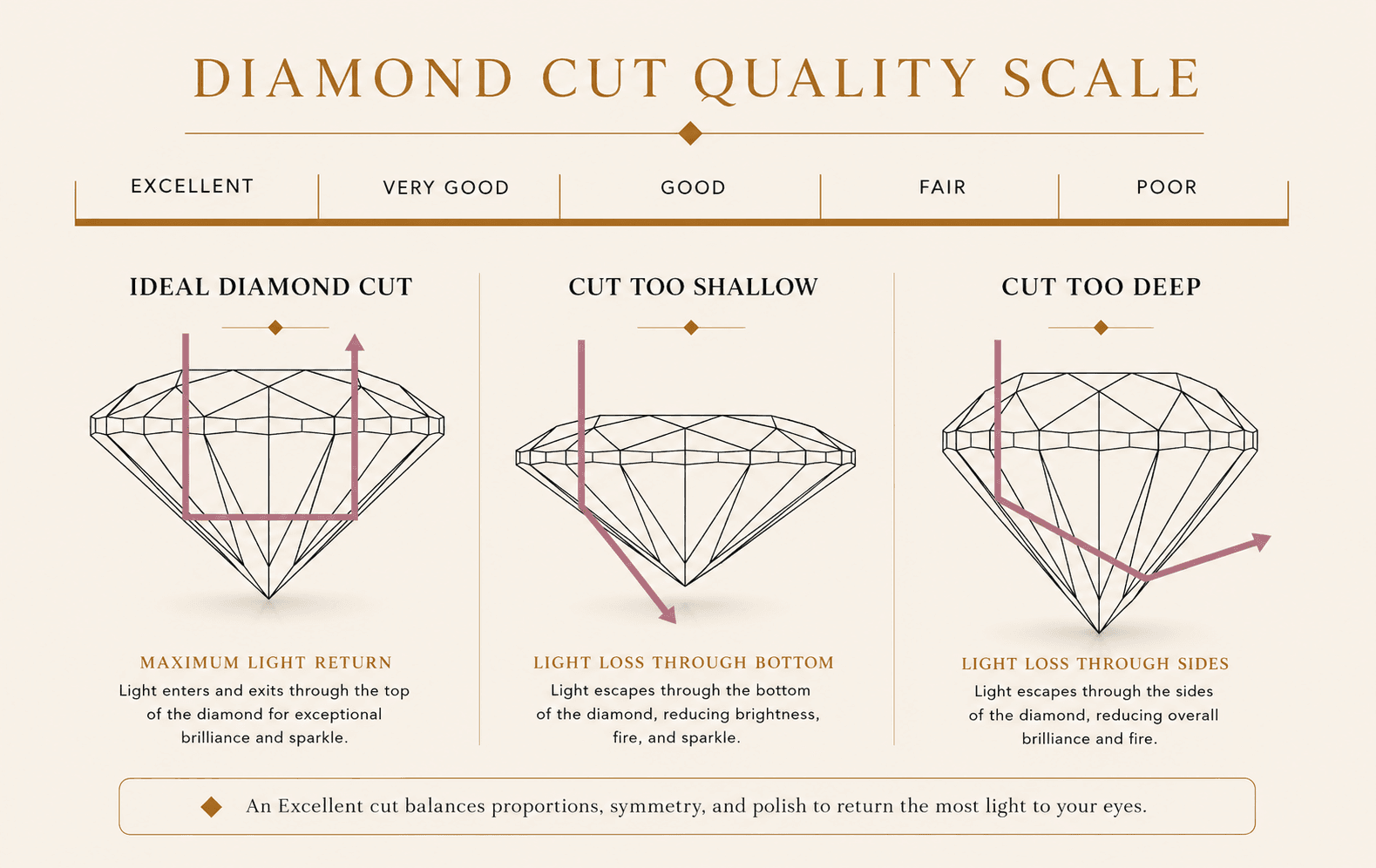
When people describe a diamond as dull or lifeless, light leakage is often the underlying reason. Even a large or high-clarity diamond can appear underwhelming if too much light escapes before it has the chance to reflect back upward.
Understanding light leakage helps explain why cut quality plays such a critical role in a diamond’s beauty.
How Light Should Behave in a Diamond
In a well-cut diamond, light enters through the table and crown facets, reflects inside the stone, and returns to the viewer through the top. The angles of the facets guide the light through this path.
Because diamond has a very high refractive index, light slows and bends when it enters the stone. This allows the internal facets to reflect the light repeatedly before it exits.
When this process works efficiently, the diamond appears bright and lively because most of the incoming light is returned.
What Causes Light Leakage
Light leakage typically occurs when the proportions of a diamond are not balanced correctly.
If a diamond is cut too shallow, light may travel straight through the bottom of the stone rather than reflecting internally. If the diamond is cut too deep, light may bounce toward the sides and escape before returning upward.
Facet alignment also plays a role. When facets are misaligned or poorly proportioned, the internal reflections may not direct light toward the viewer.
How Light Leakage Affects Appearance
Diamonds with significant light leakage often appear darker in certain areas. Instead of showing consistent brightness across the surface, the stone may display patches where light seems to disappear.
These darker areas can reduce the diamond’s overall brilliance and make the stone appear less lively. In some cases, the diamond may even look smaller than it actually is because the brightness is uneven.
A well-cut diamond distributes light more evenly, creating a balanced and vibrant appearance.
How Gemologists Detect Light Leakage
Gemologists often use specialized viewing tools to identify light leakage. Devices such as ASET scopes and Ideal-Scope viewers reveal how light interacts with the diamond’s facets.
These tools create visual patterns that highlight where light is returning and where it is escaping. Areas of leakage appear darker in these images, making them easier to identify.
Although these instruments are useful, experienced jewelers can often recognize light leakage simply by comparing diamonds under consistent lighting conditions.
The Relationship Between Light Leakage and Cut Quality
Cut quality is the primary factor that determines whether light is retained or lost within a diamond. Diamonds with well-balanced proportions allow light to reflect internally before exiting through the top.
When the proportions are incorrect, light cannot follow this path efficiently. As a result, more light escapes, reducing the diamond’s brightness and sparkle.
This is why diamond grading laboratories place such strong emphasis on cut quality when evaluating round brilliant diamonds.
Why Light Leakage Matters When Choosing a Diamond
Light leakage directly affects how bright and lively a diamond appears. A stone with excessive leakage may look dull even if it has excellent color or clarity grades, a reminder that paper grades and visual performance are not always aligned, as we discuss in Our Approach.
Because of this, many experts recommend focusing on cut quality before considering other diamond characteristics. A well-cut diamond maximizes light return and minimizes leakage, allowing the stone to display its full visual potential.
In practical terms, this means a smaller diamond with strong light performance can often appear more attractive than a larger diamond that loses too much light.
Diamond light leakage occurs when light escapes from the stone instead of returning to the viewer. This reduces brightness and can make a diamond appear darker or less vibrant.
Proper proportions and precise cutting help minimize light leakage and maximize light return. When these elements are balanced, the diamond reflects light efficiently, producing the brilliance and sparkle that make it so visually captivating.
Related topics
Continue Exploring
If you would like this applied to your own diamond or ring, a private conversation is available.