
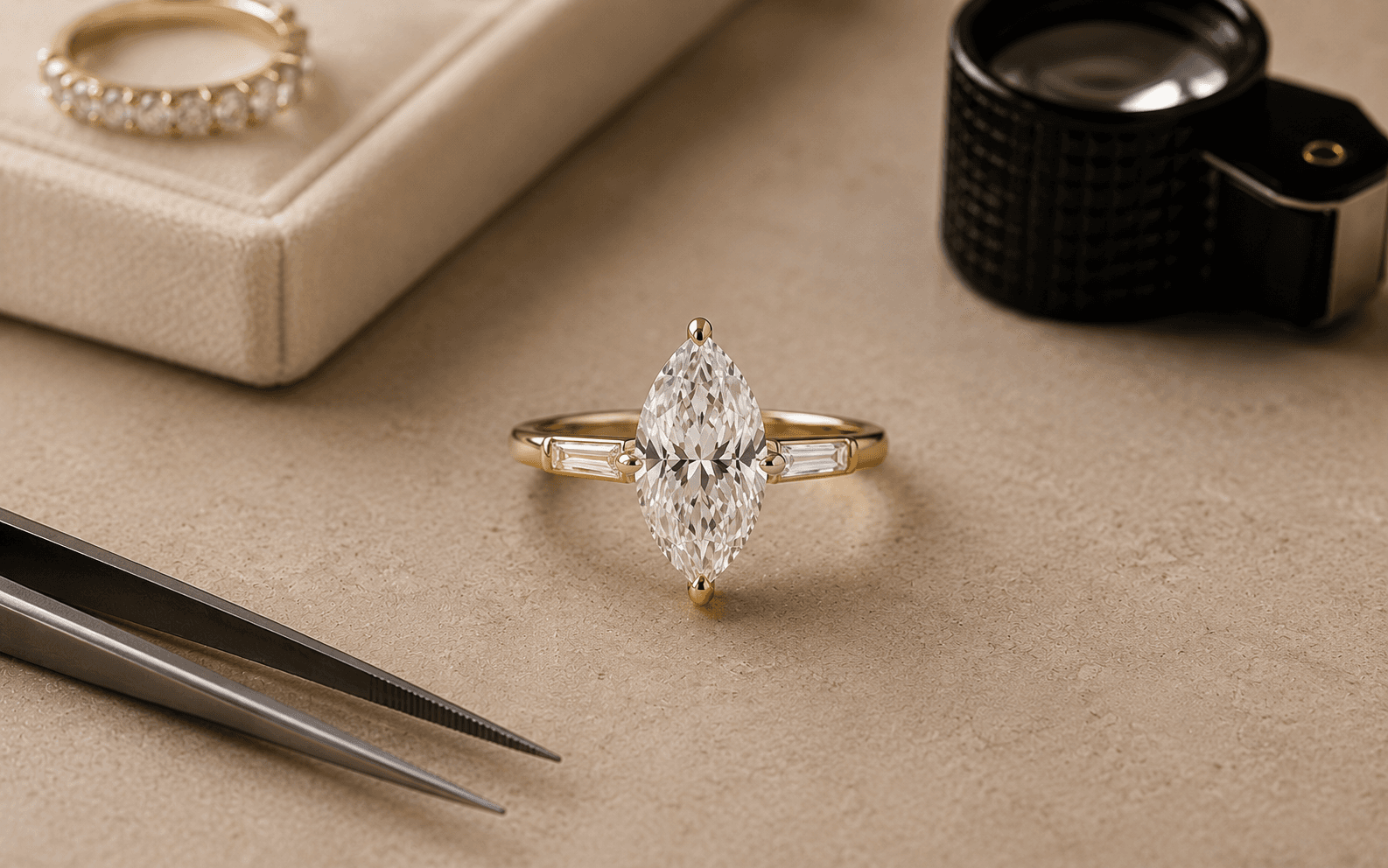
What Is a Marquise Diamond
The marquise diamond is one of the most distinctive diamond shapes used in engagement rings. Its elongated form features curved sides that taper to pointed ends, creating a shape that is both elegant and dramatic.
Sometimes described as a “navette” shape, the marquise resembles a small boat or an eye-like outline. This unique silhouette immediately stands apart from more common diamond shapes.
Most marquise diamonds are cut in a brilliant style, meaning their facets are arranged to reflect light and create sparkle similar to round diamonds.
Because of its length and narrow width, the marquise diamond often appears larger than many other shapes at the same carat weight. This gives the stone a strong visual presence on the hand.
The History of the Marquise Shape
The marquise diamond carries a fascinating history tied to European royalty.
According to popular tradition, the shape was commissioned by King Louis XV of France. He reportedly asked diamond cutters to create a stone that resembled the smile of Madame de Pompadour, one of the most influential figures at the royal court.
The resulting shape became known as the marquise cut and eventually found its way into fine jewelry across Europe.
Over time, the design evolved with modern cutting techniques, improving the brilliance and symmetry of the stone.
Today, the marquise diamond remains one of the most recognizable elongated diamond shapes.
Why Marquise Diamonds Appear Larger
One of the most notable qualities of the marquise diamond is how large it can appear on the hand.
Because the shape stretches across a longer surface area, more of the diamond is visible when viewed from above. This creates the impression of a larger stone compared to many round or square diamonds of the same carat weight.
The elongated outline also spreads the diamond across the finger, increasing its visual coverage.
For engagement ring buyers looking to maximize the appearance of size without increasing carat weight, the marquise shape can be particularly appealing. compare marquise spread on the hand to see how much finger coverage a given carat delivers.
This visual advantage is one reason the marquise diamond has remained popular over the years.
How the Marquise Shape Affects Finger Appearance
Beyond visual size, the marquise diamond also creates a distinctive effect on the hand.
The elongated outline tends to draw the eye along the length of the finger. This can create a slimming and lengthening appearance that many people find flattering.
Because the shape is symmetrical along its long axis, it naturally guides attention toward the center of the stone.
When set properly in an engagement ring, the marquise diamond often creates an elegant and graceful silhouette.
For this reason, the shape is frequently chosen by clients who appreciate elongated diamond styles.
Understanding the Bow Tie Effect
Like other elongated diamond shapes, marquise diamonds can display something known as a bow tie effect.
This refers to a darker shadow pattern that may appear across the center of the diamond when viewed face-up.
The bow tie occurs because of the way light travels through the elongated facets of the stone. Nearly all marquise diamonds will show some degree of this effect.
A faint bow tie is completely normal. What matters is that the diamond still appears bright and lively overall. What is diamond cut explains why proportion and light return matter more here than a single lab cut grade.
In well-cut stones, the bow tie blends into the surrounding brilliance rather than appearing as a harsh or distracting dark band.
Viewing the diamond under movement and different lighting can help reveal how balanced the light performance truly is. Diamond Intelligence is useful when you want report proportions and light-performance context side by side.
Setting Marquise Diamonds in Engagement Rings
Because of their pointed ends, marquise diamonds are usually set with protective prongs.
Most engagement ring designs place prongs directly over the tips of the diamond. This helps shield the points from potential impact and protects the structure of the stone.
The shape works beautifully in solitaire rings, where the elongated diamond becomes the focal point of the design.
Halo settings are also popular for marquise diamonds. A halo can emphasize the length of the stone while adding additional brilliance.
Some rings position the marquise diamond vertically along the finger, while others rotate the diamond horizontally for a more modern appearance.
Both styles can create striking engagement ring designs.
Choosing a Beautiful Marquise Diamond
When selecting a marquise diamond, symmetry is extremely important.
The two points of the diamond should align evenly, and the curves along each side should mirror each other. Any imbalance in these curves can make the diamond appear slightly uneven.
Proportions also influence the overall appearance. Some marquise diamonds appear very slender, while others feel slightly wider. Personal preference often determines which ratio feels most attractive. Length-to-width on how to read a diamond certificate is a helpful starting point before you view the stone.
Finally, the diamond should display lively sparkle across the surface of the stone rather than large dark areas.
When the shape is balanced and the light performance is strong, the marquise diamond can feel both elegant and dramatic.
The marquise diamond stands apart from most other diamond shapes because of its bold and elongated silhouette.
Its pointed ends and curved sides create a distinctive look that immediately draws attention. At the same time, its brilliant-style faceting allows the diamond to display lively sparkle.
For engagement ring buyers looking for a diamond that feels unique and expressive, the marquise cut offers a compelling option.
When carefully selected and properly set, a marquise diamond can produce an engagement ring that feels both graceful and memorable. Concierge can help you weigh bow-tie tolerance, length, and setting protection before you decide.
Related topics
Continue Exploring
If you would like this applied to your own diamond or ring, a private conversation is available.